Results & Photos

photo by Rick Horne
photo by Rick Horne

2011 Results & Photos

Results by Race Headquarters:

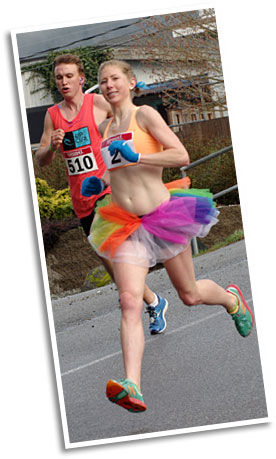
sample overlay photo from SIP

2011 Individual race photos by:

SiPhotography

Sharper Images Photography was out on course again taking pictures of AFR participants. You can search by bib number and order your images online — look for your 2011 photo here. A great memento of your race! Overlay option available (see sample at right — click to enlarge).

2011 Fools Run on Coast TV

Coast TV

Watch coverage of the 2011 Fools Run on Coast TV Channel 11. For latest schedule see Coast TV website.

Finish line video

Rick Horne of VFAC has kindly taken and posted video of the finish line up to 1:55:30. View here »
Additional photos by Rick: view here.

Race Reports by bloggers

Read runners' accounts of AFR2011 (now all direct links to exact posts!): David Palermo (2nd overall); Gillian Clayton (3rd woman); John Atkinson (4th M35-39, awards announcer)

Top

2011 Overall Winners and BC Half Marathon Champions:
Kevin O'Connor (1:09:59); Keddi-Anne Sherbino (1:18:03)

2011 Masters 40+ winners:
Kevin O'Connor (1:09:59) and Tina Connelly (1:24:36)

BC Championships: O'Connor and Sherbino, BC Half Marathon Champions

Winners of the 2011 George Matthews Memorial Award (first local finishers):
Mason Gregory of Roberts Creek (1:20:24) and Kimberley Doerksen of Gibsons (1:27:53).

Westcoast Air Team Challenge: Men's/overall: VFAC (average 1:13:15); Mixed: Westwood High School (average 1:29:06); Women's: Bellingham Sunshine (average 1:45:01).

First 2-person Relay: The Young and the Restless, Richmond (1:31:50);
First 4-person Relay: Lickety Split, Surrey (1:35:48).

Top

Important note about results/times:

We do not record net chip times in our event, only official gun times. Instead of funnelling everyone through a narrow chute to cross a start mat, we let you spread out over the entire road for the start, and everyone gets across the line within 20 seconds. If you'd like to know the small time difference, please wear your sports watch and use the chrono feature.

Gun Time is the official time.
All awards are based on GUN TIME — the time from the start of the race (gun) to when you cross the finish line as per IAAF, Athletics Canada, BC Athletics, USATF, AIMS and International Awards standards:

Excerpt from the IAAF Road Race Handbook — Pg 196 RULE 240
Note: For road races and road walking events, the official time will be the time elapsed between the start gun and the athlete reaching the finish line. However, if an athlete crosses the start line after the start gun, his time elapsed between the start and finish line can be made known to the athlete but will not be considered as official time. The order in which athletes reach the finish line will be considered as the official finish position. 196 RULE 240

Important note about GPS measurements:

Please be aware that GPS nearly always measures too long for a number of reasons, the main one being imprecise locating of each point, as well as you not running the shortest possible distance (tangents on each turn). Our course has been officially certified to be a correct half marathon distance, measured with a calibrated Jones Counter according to Athletics Canada standards. The following explains the inaccuracy of the GPS tracking:

To determine an object's location, the GPS system must receive a radio signal from at least three satellites. Since each satellite emits a unique signal, the receiver can then match the signal to the satellite and its orbital position. Distance from the receiver is then calculated (for each satellite), and from that data, the receiver accurately calculates its geographic position. But just how accurate is GPS?

What affects GPS accuracy
GPS accuracy is affected by a number of factors, including satellite positions, noise in the radio signal, atmospheric conditions, and natural barriers to the signal. Noise can create an error between 1 to 10 metres and results from static or interference from something near the receiver or something on the same frequency. Objects such a mountains or buildings between the satellite and the receiver can also produce error, sometimes up to 30 metres. The most accurate determination of position occurs when the satellite and receiver have a clear view of each other and no other objects interfere.

Obviously, mountains and clouds can not be controlled or moved, nor can interference and blockage from buildings always be prevented. These factors then, will affect GPS accuracy.

So, imagine that each data point can be off by 10-30 metres (in a circle around the correct position). Then imagine yourself running to each of these erroneous data points and you'd be zig zagging right off the course in many cases. The extra distance would add up quickly. That's what your GPS is measuring — and that's why it tells you the course is long. Even if the error for each point was only 1-2 metres, it would still mean quite a bit of extra distance. The GPS would actually give a more accurate distance if it only took a reading at the end of every road or straight section of road.

More info from Bernie Conway, Chief Certifier for Canada
"Many races have individuals who believe their Garmin even though the course has been measured by a Jones counter. I usually indicate a couple of stories one of which was when a group of measurers (including me) were validating the U.S. Men's Olympic Trials in Birmingham, Alabama we also took along a GPS to compare results. When we got into the heart of the city the Garmin couldn't tell if we were in North America since so many of the satellites were blocked by the buildings. If your course has tall buildings, large hills, large trees to the south* then expect some of the satellites to not be available to take readings. The fewer satellites, the less accurate the distance indicated."

Bernie Conway
Chief Certifier for Canada
IAAF & AIMS International Measurement Administrator for the Americas

* The majority of our course has large trees to the south!

Top